

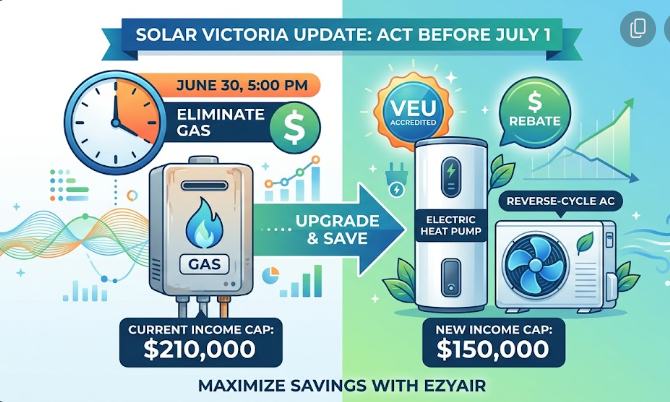
Eligibility Drops for Household Electrification Strategies
Significant structural adjustments are coming to Victoria’s clean energy incentive landscape. Solar Victoria has confirmed a major policy shift for the Solar Homes Program that will alter rebate access for thousands of households across the state.
For residents considering transitioning from gas infrastructure to energy-efficient electric alternatives, understanding these specific policy changes, strict timeline cutoffs, and regulatory frameworks is critical to optimizing available state funding.
The Policy Shift: Household Income Cap Dropping to $150,000
Beginning July 1, 2026, Solar Victoria is adjusting its financial access criteria to target lower-to-middle-income households and renters. The most significant alteration is a sharp reduction in the maximum combined household income threshold.
| Program Metric | Current Policy (Until June 30, 2026) | New Policy (Effective July 1, 2026) |
| Household Income Cap | $210,000 per year | $150,000 per year |
| Application Deadline | Must be fully submitted by 5:00 PM, June 30 | Subject to new $150k income limit |
| Application Status Requirement | Fully approved or pending final customer action | Saved/incomplete applications will lapse |
Critical Deadlines for Mid-Income Earners
If your household’s combined taxable income falls between $150,000 and $210,000, your window of eligibility for a Solar Victoria rebate closes at 5:00 PM on Tuesday, June 30, 2026.
It is important to note that simply creating an application or saving a draft within the Service Victoria portal will not preserve the older eligibility rules. Applications must be entirely finalized and submitted before the deadline. Any incomplete submissions remaining in the portal after 5:00 PM on June 30 will be evaluated under the stricter $150,000 income threshold.
The Technical Case for Gas-to-Electric Hot Water Conversion
The upcoming rebate adjustment highlights a broader state-wide push away from residential gas networks. Transitioning from a legacy gas storage or instantaneous hot water unit to a fully electric heat pump relies on thermodynamic principles to lower energy consumption.
-
Coefficient of Performance (COP): Traditional gas water heaters operate at thermal efficiencies usually between 50% and 80%. In contrast, modern electric heat pumps utilize a vapor-compression refrigeration cycle. By extracting ambient heat energy from the outside air and transferring it to the water, they regularly achieve a COP of 3.0 to 4.0. This means they generate three to four units of thermal energy for every single unit of electrical energy consumed.
-
Operational Cost Reduction: Because heat pumps draw up to 75% less electricity than conventional electric element options and fundamentally bypass fossil fuel combustion, they shield households from volatile retail gas pricing structures, particularly during peak winter demand periods.
Maximizing Regulatory Frameworks: Stacking Solar Victoria with VEU Incentives
A common point of confusion for consumers is the distinction between different state energy schemes. However, when managed by an accredited installer, these programs can be leveraged concurrently to minimize capital expenditure.
The Victorian Energy Upgrades (VEU) Program
The VEU is a market-based energy efficiency program. When a consumer replaces an inefficient appliance (like a gas hot water system or a gas space heater) with an efficient electric equivalent, the project generates Victorian Energy Efficiency Certificates (VEECs). The financial value of these certificates is passed directly to the consumer as an upfront discount.
The Double-Benefit Framework
By utilizing a VEU accredited provider, property owners can often stack the Solar Victoria Hot Water Rebate alongside VEU incentives for a single installation.
When planning home electrification, coordinating multiple upgrades simultaneously yields distinct compounding advantages:
-
Whole-Home Electrification Integration: Instead of treating hot water and space climate control as isolated projects, upgrading both hot water systems and space heating/cooling (via reverse-cycle split systems or ducted heat pumps) addresses the two largest energy consumers in a standard Victorian household.
-
Infrastructure Optimization: Combining these upgrades allows an accredited provider to assess your property’s electrical switchboard holistically. Any required circuit upgrades, safety switch installations, or phase balances can be executed in a single service visit, reducing overall labor costs and deployment friction.
-
Consistent Compliance: A single accredited entity managing both the Solar Victoria portal submissions and the VEU certificate registration ensures that all compliance documentation, certificate allocations, and electrical safety certificates match regulatory standards perfectly.
Recommended Next Steps Before the Scheme Changes
Given the expected surge in application volumes leading up to the June 30 cut-off, a structured approach is recommended to ensure eligibility is secured:
-
Verify Income Documentation: Ensure your household’s Notice of Assessment (NOA) from the Australian Taxation Office is accessible, as this is required for the Service Victoria portal validation.
-
Engage an accredited provider: Request a comprehensive site assessment from an accredited VEU provider like EZYAIR to evaluate your switchboard capacity and determine the appropriate heat pump and heating and cooling specifications for your property layout.
-
Formal Quote Generation: The installer must upload the technical quote directly into the Solar Victoria portal to trigger your application workflow.
-
Finalize Portal Declaration: Complete your identity verification and declaration via Service Victoria well ahead of the June 30 deadline to prevent system congestion delays.
- Contact EZYAIR as soon as you can to discuss your options before the program change.
