

Zoned Energy Rating Labels (ZERL) for Air Conditioners
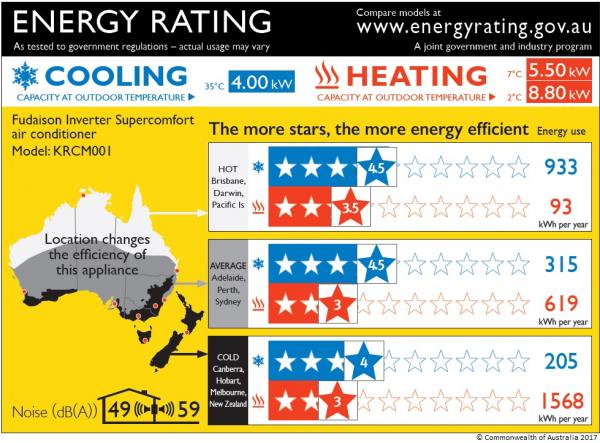
The Zoned Energy Rating Label (ZERL) rates an air conditioner's heating and cooling efficiency for three climate zones across Australia and New Zealand: hot, average and cold. Since 1 April 2020, most newly registered household air conditioners have had to carry it in place of the older single star rating label. Most of Victoria, including Melbourne, is in the cold zone.
Why the label changed
For many years the Equipment Energy Efficiency (E3) program produced an energy rating label for air conditioners that relied on a basic testing protocol. It rated a unit at set test conditions and compared its output with the electricity it consumed to give it a star rating.
The different regions of Australia and New Zealand have very different conditions, such as air temperature, cloud cover, humidity, frost and snow, and all of these affect how efficiently an air conditioner runs. The ZERL takes this into account by giving a seasonal efficiency rating for each climate zone.
How to read the Zoned Energy Rating Label
- Find your zone on the map. Melbourne and most of Victoria are in the cold zone, while the north west corner of the state is in the average zone.
- Compare the stars for your zone. There are separate cooling (blue) and heating (red) star ratings for each zone, from 1 to 10 stars. The more stars, the more efficient the unit compared with similar sized models.
- Check the output. The rated cooling and heating capacity is shown in kW. Compare units of a similar size.
- Look at the estimated annual energy use. This is shown in kWh for heating and cooling in each zone.
The ZERL must be displayed on non ducted air conditioners such as wall mounted split systems. Ducted, multi-split and three phase air conditioners, and systems over 30kW, are not required to carry it, although some carry a voluntary label, so these are compared using their technical specifications.
What the label does not tell you
The ZERL is a big step forward, but star ratings alone do not capture every difference between models. Different inverters and compressors perform differently. For example:
- If a compressor has a higher output, the air conditioner reaches the target temperature faster and the duty cycle is shorter, which can reduce energy use over time.
- If a compressor can ramp down to a lower output once the room reaches the target temperature, it uses less power while holding that temperature.
To make a fully informed decision, we also recommend comparing the technical specifications of each unit, for example:
- The cooling efficiency (seasonal energy efficiency ratio, or SEER)
- The heating efficiency (coefficient of performance, or COP)
- The operating range of the compressor (the wider the range, the more efficiently it can match the load)
- The airflow, which affects how quickly the air conditioner can heat and cool the space
How EZYAIR recommends a system
At EZYAIR, we look at each part of the installation, including your location, the space to be air conditioned and how you use it, and then recommend a product that matches your needs. While we offer a comprehensive range, we are not tied to any one brand. We compare specifications such as SEER, COP, airflow and compressor range for our customers every day, across brands including Fujitsu, Daikin, Mitsubishi Electric, Panasonic and Midea.
Resources
Frequently asked questions
What is a Zoned Energy Rating Label?
It is the energy rating label for household air conditioners in Australia and New Zealand. It gives separate heating and cooling star ratings for hot, average and cold climate zones, along with capacity in kW and estimated annual energy use.
Which zone is Melbourne in?
Melbourne and most of Victoria are in the cold zone. The north west corner of Victoria is in the average zone.
When did the Zoned Energy Rating Label start?
Since 1 April 2020, most newly registered household air conditioners have had to display the Zoned Energy Rating Label. Older labels were phased out as registrations expired.
Do ducted and multi-split air conditioners have a Zoned Energy Rating Label?
They are not required to. The label must be displayed on non ducted air conditioners such as wall mounted split systems, while ducted and multi-split systems may carry a voluntary label and are otherwise compared using their technical specifications.
Related guides
Keep reading with these related EZYAIR guides:
- How to Read a Split System Energy Label
- What Is an Inverter Air Conditioner?
- BTU, Kilowatts or Horsepower? Air Conditioner Sizes Explained
- What Are the Best Air Conditioner Brands in Australia?
- What Is a Split System Air Conditioner?
Talk to EZYAIR
Ezy Air Conditioning & Heating Pty Ltd (EZYAIR) has been helping Melbourne homes and businesses with heating and cooling since 2007. If you have a question about energy ratings or would like a quote, contact our team or call 1300 399 247, Monday to Friday, 9am to 5pm.
Our head office and display centre is at 49 Huntingdale Rd, Burwood VIC 3125.
